Blog ·
Found Again: Recovering an Adelaide Consultancy in Google, Maps and AI Search After a Website Rebuild
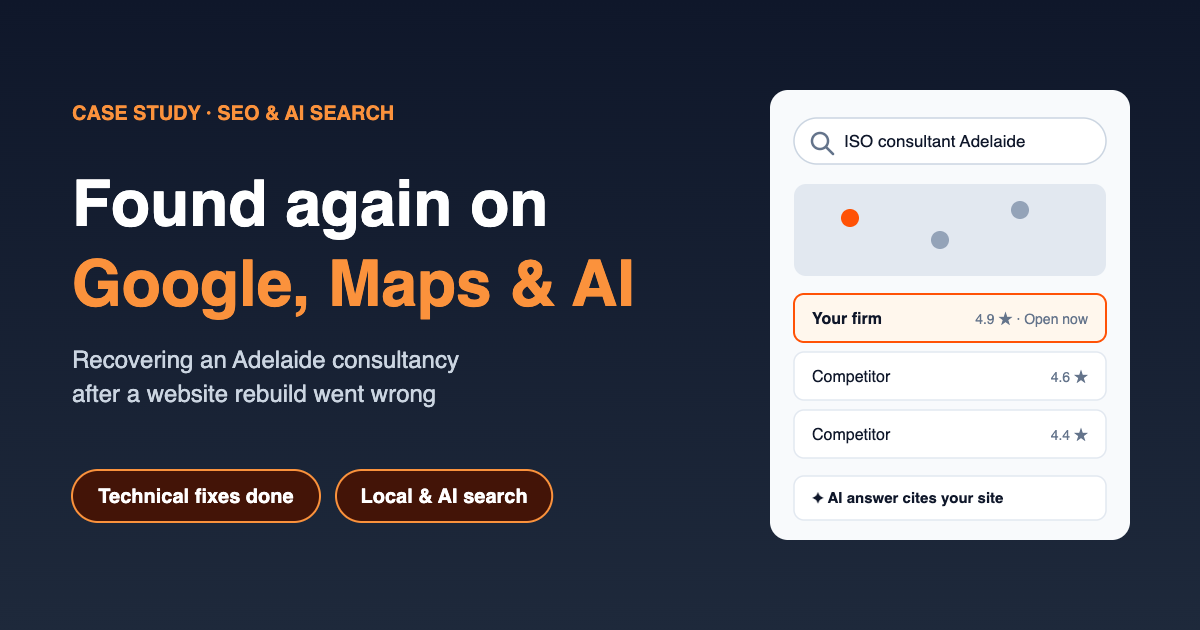
Case study: how we found why a new website stopped bringing in enquiries, fixed it, and built the business's visibility in Google Maps and AI search.
At a glance
A well-established Adelaide consultancy had a new website built. It looked far better than the old one, but within a few months new-client enquiries had slowed and the online enquiry form had gone quiet. Nobody could say why. We audited the site, fixed the technical damage from the rebuild, rebuilt their local presence across two offices, and made sure AI assistants could find and describe the business properly.
| Client | An independent business and compliance consultancy with an Adelaide city office and a regional office in Mount Gambier |
| Services | WHS consulting, ISO certification support, HR advisory and workplace training for small and mid-sized businesses |
| Platform | WordPress, rebuilt by a previous agency with a page builder theme |
| Starting point | Enquiries falling since the new site launched, competitors above them in Google Maps, and no idea what AI assistants said about them |
| Goal | More enquiries from the right clients for the right services, and a clear view of what's working |
| Approach | An SEO and AI search audit, technical fixes first, then local SEO, AI search and ongoing content |
The challenge
The consultancy had been around for years and won most of its work through referrals and a good reputation. Its old website was dated but had built up solid rankings over a long time. The new site was a big visual improvement, and everyone was happy at launch. Then things went quiet.
- Enquiries dropped after the relaunch. Not overnight, but steadily, as search engines caught up with the new site.
- Competitors were winning the searches that mattered. Searches like "ISO 9001 consultant Adelaide" or "WHS consultant Mount Gambier" showed other firms in the Google Maps results and above them in the listings.
- Two offices, one muddled presence. The Mount Gambier office had its own Google Business Profile, set up years earlier by a former staff member, with an old phone number and nobody able to log in.
- AI was a blind spot. New clients had started mentioning they'd "asked ChatGPT" which consultants to talk to. When the directors tried it themselves, their firm didn't come up.
- Past SEO had been reports, not results. They'd paid for monthly SEO before. Each month brought a report of issues, but the fixes needed a developer, and the developer was a different company.
Phase 1: The audit
We started with an SEO and AI search audit: a full crawl of the site, a review of Google Search Console and Analytics, a look at the top-ranking competitors, a check of every place the business was listed online, and a set of real client questions put to the major AI tools.
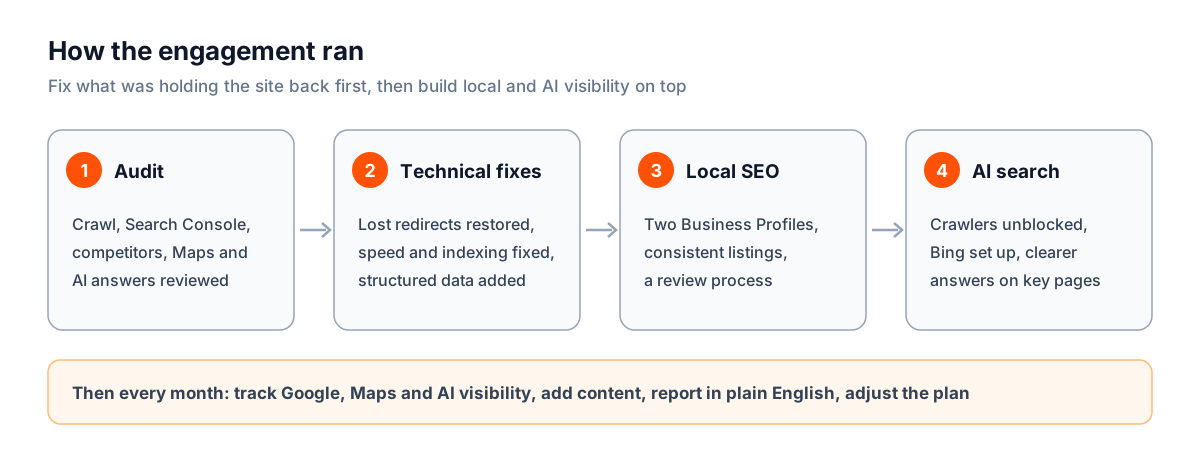
The audit found plenty, but a handful of issues explained most of the drop. We ranked every finding by impact and effort, so the business could see what mattered and what didn't.
| Finding | Why it mattered | Effort |
|---|---|---|
| Old page addresses no longer worked and had no redirects | Years of rankings, and links from suppliers and directories, now led to "page not found" | Low |
| Service area pages were set to "noindex" | A setting left over from the build told Google to ignore some of the most valuable pages on the site | Low |
| The firewall was blocking AI search crawlers | The tools behind AI answers couldn't read the site at all | Low |
| The site had never been set up in Bing | Microsoft Copilot relies on Bing, and the site was barely indexed there | Low |
| Mobile pages were slow to load | The page builder loaded large images, sliders and scripts on every page, even where they weren't used | Medium |
| Inconsistent business details online | Different phone numbers and addresses across directories, and an orphaned second Business Profile | Medium |
| One page for all services | A single "Services" page tried to rank for everything, and so ranked well for nothing | Medium |
Several of the most damaging problems took minutes to fix once found. That's common after a rebuild. The expensive part is usually not the fix but the months of lost enquiries before anyone notices.
Phase 2: Technical fixes, done for them
Because we build and host websites ourselves, we didn't hand over a list. We made the changes directly.
- Redirects restored. We pulled the old site's addresses from Search Console, the web archive and backlink data, mapped each one to its closest new page, and set up permanent redirects. Links from suppliers and directories started passing value again.
- Indexing fixed. We removed the leftover "noindex" settings, cleaned up duplicate versions of pages created by the theme, and made sure the XML sitemap only listed real, indexable pages with accurate last-updated dates.
- Speed improved at the source. Rather than adding another optimisation plugin, we removed what wasn't needed. Images were resized and served in modern formats, the slider was replaced with a static hero, and scripts and icon fonts were trimmed to what each page actually used.
- Structured data added. We added schema markup describing the business, both offices, its services, opening hours, accreditations and professional memberships, plus breadcrumbs and FAQs, so search engines and AI tools could read the key facts reliably.
None of this was glamorous, but it was the foundation for everything after it. There's little point building content and reputation on a site that search engines can't crawl properly.
Phase 3: Local SEO across two locations
Consultancies often assume local search is only for shops and trades, but searches like "WHS consultant Adelaide" show a map of firms first, and plenty of new clients start there. Local rankings depend on relevance, distance and prominence, and while the consultancy couldn't move its offices, the other two were in its control.
- Both Business Profiles brought under control. We recovered access to the Mount Gambier profile through Google's ownership process, corrected its details, and set both profiles up with the right primary and secondary categories, services, service areas, hours and photos of the team and offices.
- Consistent details everywhere. We corrected the business name, addresses and phone numbers across Australian directories, Bing Places, Apple Business Connect and industry listings, so every source agreed.
- A review process that runs itself. The consultancy already sent a close-out email from its CRM when a project finished. We added a short, polite request for a Google review to that email, linked to the right profile for each office. No incentives, no gating, just asking happy clients at the right moment. The team also started replying to every review.
- Pages for real services and real areas. The single "Services" page became dedicated pages for WHS consulting, ISO 9001, ISO 45001 and ISO 14001 certification, HR advisory and workplace training. Each office got a genuine location page covering the areas and industries it serves, with local client examples and the team based there rather than a list of town names.
Phase 4: Making the business visible in AI search
We built a set of questions a prospective client might actually ask an AI assistant. For example:
"Who can help a small manufacturer get ISO 9001 certified in South Australia?"
"What does a WHS audit involve, and does my business need one?"
"Recommend an HR and compliance consultant in Mount Gambier."
We put these to ChatGPT, Gemini, Copilot, Perplexity and Google's AI Overviews, and recorded which businesses were mentioned and which sites were cited. That gave us a baseline to measure against. The work then focused on what AI search tools actually rely on:
- Access first. The firewall's bot protection had been blocking the crawlers that AI search tools use to fetch pages. We adjusted it to allow the search and answer crawlers the business wanted to be seen by, while keeping its chosen controls over AI training.
- Bing, properly. We verified the site in Bing Webmaster Tools, submitted the sitemap and set up IndexNow, so new and updated pages reach Bing quickly. That matters for Copilot and for other AI tools that draw on Bing results.
- Answers worth quoting. The new service pages open with a clear, direct explanation of the service, who it's for and what it involves, followed by honest pricing guidance and common questions. That's what people want to read, and it's also the kind of content AI tools quote and cite.
- One consistent identity. The same business description, services, locations, accreditations and memberships now appear on the website, both Business Profiles, Bing, the directories and social profiles. When every source agrees, AI tools can describe the consultancy with confidence.
- Reputation that AI can see. The growing number of recent, detailed reviews, plus listings on reputable industry and local sites, give AI tools reasons to recommend the consultancy and not just know it exists.
We were upfront that nobody can guarantee what an AI assistant will say. Answers vary between conversations and change as the tools are updated. What we can do is remove the barriers, strengthen the signals they rely on, and track the trend over many questions rather than one screenshot.
Ongoing: content and reporting
With the foundations in place, the engagement moved to a monthly rhythm. Each month we fix anything new that monitoring picks up, add or improve content, keep both Business Profiles active, and report.
The content plan comes straight from what prospective clients search for and ask. It includes guides such as what ISO certification involves and how long it takes, the WHS obligations small businesses most often miss, and what to expect from a compliance audit. Each guide links to the matching service page and answers the questions the consultants are asked in first meetings every week.
What we measure
We agreed the measures with the business at the start and report on them every month, in plain English:
- Enquiries and calls from search: form submissions, calls from the website and calls from each Business Profile
- Google visibility: clicks, impressions and the searches the site appears for, from Search Console
- Map rankings: positions for key searches, tracked from points across each office's service area
- AI search visibility: how often the business is mentioned or cited across the tracked set of questions, and visits arriving from AI tools
- Reviews: new reviews, average rating and response rate for each location
- Work completed: what changed, why, and what's planned next
The numbers decide what happens next. If one service or area is responding well, we do more of it. If a competitor starts outranking us for a particular search, we look at why.
Lessons
- A rebuild is the riskiest moment for your rankings. Plan redirects and search settings before launch, not after. It's far cheaper than recovering lost enquiries.
- The biggest problems are often the quickest fixes. A forgotten "noindex" or a missing redirect can do more damage than anything else, and take minutes to correct once someone finds it.
- Reports don't fix websites. If the people finding the problems can't fix them, the problems tend to stay on the list. Having one team do both makes the difference.
- Check what your firewall is blocking. Security settings that block AI crawlers can quietly remove you from AI answers, and nobody will tell you.
- AI search rewards the basics done well. Clear pages, consistent details and a genuine reputation help in Google, in Maps and in AI answers alike.
Is your website bringing in the enquiries it should? Our SEO and AI search audit shows you exactly what's holding it back and what to fix first. You can also read more about our SEO services, local SEO and AI SEO, or get in touch and tell us what's going on.